
Quick answer
Minoxidil is the only topical treatment with real, large-scale clinical trial evidence behind it, not just brand marketing. In the biggest post-marketing study (902 patients), about 84% saw some benefit, though only roughly 30-40% of users get what clinicians would call a meaningful result. It also comes with a genuinely rough start: most people go through a shedding phase in the first few weeks that can run 4 to 12 weeks depending on strength, and it’s the single biggest reason people quit before it’s had a chance to work. Real results take 4 months on average, sometimes 6 to 12. If you’re not prepared for that timeline, you’ll likely stop right before it would have started working.
Why trust this: every clinical figure below is sourced from real trials and post-marketing studies, linked at the bottom of this article, not repeated brand marketing copy. See our Methodology page for how we vet everything on this site.
Reviewed against current clinical literature: 23 August 2026.
How it actually works
Minoxidil was originally a blood pressure medication. Doctors noticed a side effect: patients grew hair in places they hadn’t before. Applied to the scalp, it widens blood vessels and appears to extend the growth phase of the hair cycle, pushing more follicles into active growth rather than sitting dormant. The FDA approved it for hair loss in 1988, the first drug ever proven to regrow hair rather than just slow its loss, and it’s been the benchmark every other treatment gets measured against since.
In the UK, the Regaine for Men solution and foam are General Sales List medicines according to their product leaflet, so you don’t need a prescription. It comes in two strengths: 2% and 5%. Men typically use 5% foam or solution twice daily. Women typically use 5% foam once daily, or 2% solution twice daily, the lower frequency partly because higher concentrations carry a higher rate of scalp irritation.
Not sure whether minoxidil is even the right starting point for what you’re seeing? Our Methodology page explains how we vet every product on this site, and our scalp exfoliation guide and Hair Loss Treatments picks are a good next stop once you’ve read the evidence below.
What the clinical evidence actually shows
This is the part most product pages skip entirely, because the real numbers are less flattering than “clinically proven.”
In a large post-marketing study of 902 patients, 5% topical minoxidil was rated “very effective” in 15.9%, “effective” in 47.8%, “moderately effective” in 20.6%, and “ineffective” in 15.7%. Add those up and roughly 84% saw some degree of benefit. But “some benefit” and “meaningful result” aren’t the same thing: separate clinical sources put the share of users who get what’s considered a genuinely meaningful response at closer to 30-40%.
Strength matters. A randomized trial comparing concentrations found 5% minoxidil produced 45% more hair regrowth than 2% by week 48, which is why 5% is now the more commonly recommended strength for men specifically.
It’s not just a men’s product. A 48-week trial of 381 women with female pattern hair loss found 5% minoxidil beat placebo on all three of the study’s primary measures. In a separate UK-referenced trial, 60% of men using minoxidil reported more hair coverage after 48 weeks, against 23% on placebo, a real gap, but also a reminder that even placebo groups saw some improvement, hair growth has always been somewhat variable and self-reported.
The minoxidil shedding phase nobody warns you about
This is the single most common reason people quit in month two, right before the treatment would have started working.
Shedding usually starts within the first few weeks. The Regaine product leaflets say it generally happens two to six weeks after you start and settles within a couple of weeks, and that if it lasts more than two weeks you should stop and talk to a doctor. How long it lasts also depends on strength: a 2025 study found 5% minoxidil users typically shed for 4 to 8 weeks, while 2% users shed for longer, around 8 to 12 weeks, with the worst of it landing somewhere between weeks 4 and 8 either way. It looks like the opposite of what you paid for. It isn’t. Minoxidil pushes resting follicles into a new growth cycle, and the hair they’re replacing has to fall out first to make room. Old hair goes, thicker new hair grows in behind it.
Knowing this in advance doesn’t make it pleasant to watch happen in the shower drain, but it does mean you’re less likely to stop a treatment that’s actually starting to do its job.
Realistic timeline
- First few weeks: shedding may begin. The Regaine leaflets say two to six weeks; on 5% a 2025 study found it usually runs 4 to 8 weeks, on 2% closer to 8 to 12. This is expected, not a sign the product is wrong for you.
- Weeks 4-8: shedding typically peaks, then tapers off.
- Months 2-4: the earliest point most people start noticing any real change, if they notice one at all.
- Months 4-6: the average point where visible results show up, for those who respond.
- Months 12-18: the point where results, if they’re coming, are usually at their best.
Stopping before month 4 because “it’s not working” is the most common way people fail to get a fair read on whether minoxidil suits them.
Side effects and who shouldn’t use it
The most common side effect is contact dermatitis, itching and scaling of the scalp, and it shows up more often with the 5% strength than the 2%. For most people this is manageable irritation, not a reason to stop outright, but it’s worth taking seriously if it’s severe or doesn’t settle.
Minoxidil isn’t the right first step for everyone. It’s not recommended if:
- You’re pregnant or breastfeeding.
- You’re under 18.
- Your hair loss is sudden, patchy, or unexplained, or started after childbirth. These patterns can have causes minoxidil doesn’t treat, and are worth a GP visit before you spend money on a product that isn’t built for the actual problem.
- You have an active scalp infection or inflammation.
A separate note on oral minoxidil, a different product taken as a tablet, not covered by anything above: it carries real cardiovascular risks (low blood pressure, fluid retention, and in more serious cases a risk factor for heart failure) that topical minoxidil doesn’t share, because very little of it is absorbed into the bloodstream through the skin. If a clinic or online prescriber suggests oral minoxidil, that’s a different risk conversation with a doctor, not a like-for-like swap for the topical version this article covers.
Related: Genetics, stress or diet: what is actually causing your hair loss?
Related: Minoxidil UK price: Regaine vs Sons cost per month
FAQs
How long before I know if minoxidil is working for me?
Give it a genuine 4 months before judging it, since that’s the average point real results start showing up, and don’t be discouraged by shedding in the first few weeks, that’s expected, not a failure sign. The Regaine leaflets say it generally appears two to six weeks in and to talk to a doctor if it lasts more than two weeks.
Do I have to keep using it forever?
Yes, if you want to keep the results. Minoxidil maintains hair it helped grow, it doesn’t provide a permanent fix. Stopping typically means gradually losing the gains over the following months.
Is 5% always better than 2%?
For men, the evidence favours 5% (45% more regrowth than 2% in one trial). For women, the once-daily 5% foam and twice-daily 2% solution are both established options, the right choice often comes down to which routine you’ll actually stick to and how your scalp tolerates the stronger strength.
Can I use minoxidil alongside other hair loss products, like a caffeine shampoo or a DHT-blocking system?
There’s no direct conflict, minoxidil works through a different mechanism to caffeine-based products. Many people do combine them. Just don’t expect a shampoo or scalp system to substitute for minoxidil’s own clinical evidence, they’re not interchangeable. If you’re weighing a caffeine shampoo specifically, our Nioxin vs Alpecin breakdown covers the honest differences.
Does anything actually make minoxidil work better, rather than just being a separate product?
Microneedling is the one addition with real randomized-trial evidence behind it specifically as a minoxidil booster, not just a standalone product. Our microneedling and minoxidil breakdown covers the actual numbers, the safe needle depth, and how often to do it.
Where to buy
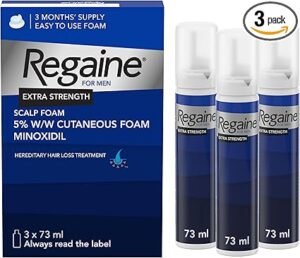
The only OTC ingredient with real clinical backing behind it, and the actual minoxidil most UK reviewers we read have real experience with. Expect a slow build, and some scalp irritation early on is common.
Regaine For Men Hair Regrowth Foam Last checked Sep 2026Invigare is reader-supported. We may earn a commission from qualifying purchases made through links on this page, across multiple retailers and affiliate programmes. This never affects which product we recommend first. Full Affiliate Disclosure and Methodology.
This content is informational only and isn’t a substitute for professional medical or dermatological advice. If your hair loss is sudden, patchy, or unexplained, see a GP before starting any treatment.
Sources
- Minoxidil Shedding: Why It Happens and When It Stops (Ro)
- A randomized clinical trial of 5% topical minoxidil versus 2% topical minoxidil and placebo in the treatment of androgenetic alopecia in men (PubMed)
- A randomized, placebo-controlled trial of 5% and 2% topical minoxidil solutions in the treatment of female pattern hair loss (PubMed)
- Minoxidil: Comprehensive Scientific Review for Hair Loss (The Independent Pharmacy)
- Minoxidil Hair Loss Treatment Effectiveness Explained (Shapiro Medical)
- Contact Dermatitis Caused by Topical Minoxidil: Allergy or Just Irritation (PMC)
- Who Should Not Use Minoxidil? Risks, Contraindications, and Safety
- What is Minoxidil Regaine? (LloydsPharmacy Online Doctor UK)
- Regaine Hair Loss Side Effects: UK Guide to Minoxidil Safety (Bolt Pharmacy)