
Quick answer
Hair fibres are a cosmetic concealer, not a treatment. Keratin fibres cling to your existing hair via static charge, making thinning areas look visibly denser within seconds. They don’t regrow hair and don’t affect your follicles, and they wash out completely with normal shampooing. They’re worth using if you want to look denser today while a real treatment works over months. They’re not worth using as a replacement for one.
Why trust this: every claim below is sourced and linked at the bottom of this article. See our Methodology page for how we vet everything on this site.
Reviewed against current literature: 15 September 2026.
Best for
- You, if: you want an instant, same-day change in how dense your hair looks, and you’re happy to reapply it daily as a cosmetic step, not a cure.
- Not you, if: you’re looking for anything that regrows hair, or you have an area that’s fully bald rather than thinning. Fibres need existing hair to cling to.
- Not the same as: a treatment like minoxidil. Fibres change how thinning hair looks today. Minoxidil aims to change how much hair you actually have, over months, not days.
The Invigare Verdict
Hair fibres do exactly one job well: an instant, reversible, cosmetically neutral change in visual density, with real safety evidence behind the mechanism, not just marketing claims. The category’s real weak points, colour-matching and durability in wind or rain, are inconvenience-level, not safety-level. Used alongside an actual treatment rather than instead of one, this is one of the more honestly-marketable products in the hair-loss space, because unlike most listings in this category, nobody credible is claiming it does more than it does.
How do hair fibres actually work?
Hair fibres are keratin particles, the same protein your hair is made of, cut small enough to cling to individual strands. Friction gives each fibre a static charge as it leaves the bottle. Your hair carries a different charge, so the fibres are physically drawn to it and wrap around each strand, the same static effect that makes a wool sock stick to a fleece blanket in a tumble dryer.
This is a purely mechanical, cosmetic effect. Fibres sit on top of hair that already exists. There’s nothing for them to cling to on truly bald skin, and nothing about the process reaches your scalp or follicles.
Are hair fibres safe to use?
Yes, for most people. Because fibres are applied topically and don’t penetrate the skin, they don’t enter the bloodstream and don’t affect hair growth in either direction. They neither help nor harm the follicles underneath.
The most common real complaint is scalp irritation, and it traces back to one of two causes:
- A contact sensitivity to a specific ingredient. Wool-based keratin is the most frequently reported trigger for people with wool allergies. Silica, ammonium chloride, and synthetic binders like nylon 6/12 are the other ingredients most often named in irritation reports.
- Product buildup from leaving fibres on too long without washing, letting fibres, natural oils, and sweat accumulate together.
Fibres are water-soluble and wash out completely with a normal shampoo, no special removal product needed. The general best-practice guidance is to remove them before bed and reapply fresh the next day, rather than leaving one application on for multiple days.
What are the real pros and cons of hair fibres?
| Hair fibres | |
|---|---|
| What they do well | Instant, same-day density change; natural fibrous texture, not an obvious powder; no damage to existing hair; fully reversible; safe alongside minoxidil or finasteride |
| What they don’t do | Don’t regrow a single hair; need existing hair to cling to, so won’t help a fully bald patch; a recurring cost, not a one-time fix, since every application washes out |
| Known weak points | Cheaper, poorly-formulated fibres can show a green tinge in sweat; colour-matching is trial and error for many users; visible shift or thinning in wind and heavy rain |
Get the colour match wrong and thinning areas can look more obvious, not less, especially under bright light or in the rain.
Where to buy
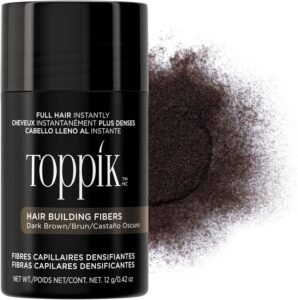
A different tool entirely from everything else on this list, since this does not treat hair loss, it hides it instantly. Keratin fibres cling to existing hair via static charge, filling in thinning areas and the scalp show-through in seconds. Genuinely useful as a confidence bridge while an actual treatment does its slower work, not a substitute for one. Real caveat: colour-matching your exact shade is trial and error, and it needs a proper wash to fully remove, so factor that into your routine.
Toppik Hair Building Fibres Last checked Sep 2026Related: Nioxin vs Alpecin: which is actually worth it?
FAQs
Do hair fibres damage your hair long-term?
No. Fibres are cosmetically neutral. They don’t nourish hair, but they don’t damage it either, since the effect is purely a static-cling coating on the outside of strands you already have.
Can hair fibres cause scalp irritation?
For most people, no. When irritation happens, it’s usually a sensitivity to a specific ingredient (wool-derived keratin, silica, or ammonium chloride are the most commonly reported) or a buildup issue from not washing fibres out daily, not the fibres themselves being inherently irritating.
Will hair fibres work on a fully bald spot?
No. Fibres cling to existing hair strands via static charge. With nothing to cling to on bald skin, they won’t create the effect there.
How do you remove hair fibres?
A normal shampoo fully dissolves and removes them, no special product or process needed. Removing them before bed rather than sleeping in them is the generally recommended habit.
Do hair fibres work with minoxidil or finasteride?
Yes. Fibres are a cosmetic layer on top of existing hair and don’t interact with either treatment. Many users apply fibres for daily appearance while minoxidil or finasteride works over the months it takes to show real results.
Invigare is reader-supported. We may earn a commission from qualifying purchases made through links on this page, across multiple retailers and affiliate programmes. This never affects which product we recommend first. Full Affiliate Disclosure and Methodology.
This content is informational only and isn’t a substitute for professional medical or dermatological advice. If you have a known wool or keratin sensitivity, or a scalp condition, check with a pharmacist or dermatologist before use.